Notre Dame de Jérusalem
The Chapelle St. Pierre in Villefranche-sur-Mer was the first in a row of Chapels and Churches Jean Cocteau adorned with his characteristical man size murals. He created stained glas windows for the Church of St. Maximin in Metz, murals for the church of Notre Dame de France in London and the Chapelle Saint-Blaise in Milly-la-Forêt, his last resting place.
 In religious symbolism, the octagon or the figure 8 represent resurrection, rebirth and eternal life. Jesus' resurrection took place eight days after his arrival in Jerusalem. Today this symbolism can still be seen in many baptismal fonts in churches all over the world. It is also the shape of the Dome of the Rock, housing the sacred stone that allegedly once supported the Ark of the Covenant.
The building is literally crowned with an iron construction in the shape of a crown. The Chapel is a veritable treasure trove of religious and esoteric imagery. Outside there are magnificently bright and colorful mosaics. Pièce de resistance however, without any doubt is the 360 degree panoramic mural on the eight walls and ceiling of the Chapel's inside. It's literally all around you and quite overwhelming when you first see it. It's adorned by a beautiful floor mosaic. You can get a perfect impression of the Chapel by using the panorama viewer below. It requires the free Quicktime application to be installed on your computer.
In religious symbolism, the octagon or the figure 8 represent resurrection, rebirth and eternal life. Jesus' resurrection took place eight days after his arrival in Jerusalem. Today this symbolism can still be seen in many baptismal fonts in churches all over the world. It is also the shape of the Dome of the Rock, housing the sacred stone that allegedly once supported the Ark of the Covenant.
The building is literally crowned with an iron construction in the shape of a crown. The Chapel is a veritable treasure trove of religious and esoteric imagery. Outside there are magnificently bright and colorful mosaics. Pièce de resistance however, without any doubt is the 360 degree panoramic mural on the eight walls and ceiling of the Chapel's inside. It's literally all around you and quite overwhelming when you first see it. It's adorned by a beautiful floor mosaic. You can get a perfect impression of the Chapel by using the panorama viewer below. It requires the free Quicktime application to be installed on your computer.
The Order of the Knights of the Holy Sepulchre
 Cocteau devised a very clear theme for his Chapel of Our Lady of Jerusalem. The Jerusalem Cross or Cross with Cross Potent is omnipresent, in fact it appears to have been the basis for the octagonal floorplan. The Jerusalem Cross was a variant of the Crusaders' Cross (symbol of the Crusader Kingdom of Jerusalem). It was the logo of the Order of the Knights and Dames of the Holy Sepulchre of Jerusalem.
The four smaller crosses are said to symbolize either the four books of the Gospel or the four directions in which the Word of Christ spread from Jerusalem. Most frequently however the five crosses symbolize the five wounds of Christ during the Passion. It is here that the Arma Christi come to mind again. The association with Christ's wounds seems very relevant here given the content of the murals that mostly depict scenes from the Passion of Christ.
Cocteau devised a very clear theme for his Chapel of Our Lady of Jerusalem. The Jerusalem Cross or Cross with Cross Potent is omnipresent, in fact it appears to have been the basis for the octagonal floorplan. The Jerusalem Cross was a variant of the Crusaders' Cross (symbol of the Crusader Kingdom of Jerusalem). It was the logo of the Order of the Knights and Dames of the Holy Sepulchre of Jerusalem.
The four smaller crosses are said to symbolize either the four books of the Gospel or the four directions in which the Word of Christ spread from Jerusalem. Most frequently however the five crosses symbolize the five wounds of Christ during the Passion. It is here that the Arma Christi come to mind again. The association with Christ's wounds seems very relevant here given the content of the murals that mostly depict scenes from the Passion of Christ.
God Wills It
The Jerusalem Cross is not the only thing that refers to the Crusades and the Crusader Kingdom. Cocteau appears to have adopted the motto of the First Crusade for his Chapel. At the Council of Clermont in November 1095, pope Urban II held what must have been one of the most powerful speeches in history. A French Nobleman himself, he summoned the French nobility to free the Holy Land and the Holy city from the hands of the Persians. His words that survive today leave little to the imagination: "You, who sell for vile pay the strenght of your arms to the fury of others, armed with the sword of the Machabees, go and merit an eternal award. If you triumph over your enemies, the kingdons of the East will be your reward. If you are conquered, you will have the glory of dying in the very same place as Jesus Christ, and God will never forget what he found you in the Holy Batallions. This is now the time to prove that you are animated by true courage, the time to expiate violence committed in the bosom of peace, the many victories purchased at the expense of justice and humanity. If you must have blood, bathe in the blood of the infidels. I speak to you with harshness because my ministry obliges me to do so. Soldiers of Hell, become soldiers of the living God! His speech was answered by a loud roar from the crowds. The northerns shouted 'Dieu li volt!'; the southerns in their own tongue: 'Dieu le veult!'.
The Murals
The eight walls of the octagon are decorated with as many tableaus:
1. The Last Supper
In the last supper we see Jesus, surrounded by his twelve disciples. It's hard to tell who is who. The grouping doesn't match Da Vinci's last supper in Milan so we can't identify the apostle from there. Christ is in the middle. A female figure is leaning against his shoulder on the right, probably John or perhaps Mary Magdalene. Judging by the face, the size and the dress, the figure is androgynous to say the least. We know John has been depicted with some femininity through the ages. On the other hand, the gospels state clearly that Mary Magdalene was present at the Last Supper, so why couldn't she have been at the table? Remember that in the early 60's it wasn't fashionable yet to stage Mary Magdalene besides Jesus as his wife or mother of his children; Jean Cocteau couldn't have been influenced by Holy Blood, Holy Grail or The Da Vinci Code. If the figure is indeed John or Mary Magdalene, there is an inversion going on, since he (or she) is usually depicted on Christ's left. For the remainder of the article I will call this figure Mary Magdalene. Although I can't be 100% sure I think the figure is more feminin than masculin. In front of Christ there's a glass of what appears to be red wine often symbolising blood. Perhaps Cocteau is confirming the fact that the Grail and the Holy Blood are in fact one. This too in an age where the translation of San Graal into Sang Real hadn't been invented yet. On the far left there appears to be a second portrait of Marais, but a younger version with longer hair this time. Given the profile of the face of the man on his right, it might very well represent Cocteau in a second but younger and more stylised self portrait. Here Jean Marais seems to have little interest in Jesus but Cocteau is staring at him in admiration. Metaforically we are looking at the young Cocteau admiring Christ, but looking away from him when he is older. Something appears to have happened that made him turn away from Christ.
2. Insulting of Christ
This is the scene from the Passion, where Jesus is mocked by and given the Crown of Thorns. This part of the mural doesn't have the specific distinguished style of painting of Jean Cocteau. It's likely it was done by Edouard Dermit. Cocteau was very specific in his sketches so the scene should be displayed as he intended. We see two figures mocking Jesus. One is clearly a Roman soldier, the other one probably a jew, judging by his dress. Christ's hands are tied and his left hand makes a peculiar gesture, as if imitating a walking mouse. On the right we see a woman praying with her eyes closed and face turned away from Christ, perhaps Mary.3. The Crucifixion
This too appears to be the work of Dermit. The crucifixion is depicted from an unfamiliar angle, looking up from the bottom of the cross. Two mirrored angels make the 'J' and inversed 'J' gesture, while holding the cross bearing Orb or Globus Cruciger. It normally symbolises Christ's dominion over the world. In this context, with the angels holding it, making the gesture at the feet of the dead Christ it could have a different meaning alltogether.4. The Virgin of the Rose
Over the door leading to the small Sacristie, a mural is painted of a crowned woman, whose crown is overgrown with rose stalks. She is looking sadly into the direction of the Blason over the front entrance. Two giant roses adorn her on both sides. From the Middle Ages, the rose was seen as the queen of flowers, symbolysing the Virgin Mary. What is odd here is that normally she is represented by a thornless rose to indicate she is without sin. Not so here, her crown is oovergrown with thorny stems. What was her sin?5. The Resurrection
Straight opposite the Last Supper, on the other side of the room there's a mural of the Resurrection, this time clearly from the hand of the master himself. An Angel lifts the veil and uncovers a figure much to the suprise of the two Roman soldiers. It's a strange scene indeed. Again, there's the inversed 'J' symbol. The most prominent mystery here is the identity of the figure behind the veil. It seems a woman rather than a man from the shape of the body. Closer inspection reveals that the figure has no beard. It's not Jesus that is resurrected here. Actually the figure looks a lot more like the person from the Last Supper identified as Mary Magdalene or maybe John. Perhaps there's a clue in the outstretched hand of the left soldier displaying the 'Five' symbol again, the Last Supper taking place on a Thursday (the fifth day of the week in Jewish custom where Sunday was the first day).6. Angel of the Apocalypse
 Before an enormous buring sun, an angel blows the trumpet to announce the Apocalypse.
He is standing in front of an enormous orange sun. His chest is adorned with a cross. His wings spread out wide.
You can only wonder what he was meant to announce here in the strange combination of symbolism and religion.
Before an enormous buring sun, an angel blows the trumpet to announce the Apocalypse.
He is standing in front of an enormous orange sun. His chest is adorned with a cross. His wings spread out wide.
You can only wonder what he was meant to announce here in the strange combination of symbolism and religion.
7. Adoration of Christ
8. Blason
Over the front entrance of the Chapel, a giant colorful Blason is painted in Cocteau's hand. Two mirrored winged figures are painted around a shield with the Jerusalem Cross. At the bottom there's a figure with an Egyptian looking headdress but he is wearing a necklace with a Christian cross. The black color and the facial expression indicate she is mourning. The whole thing is painted like some kind of blason or coat of arms. In the picture there are some symmetrical black and red dots. I tried to connect them but it hasn't led to a distinguishable image so far. I am interested to hear if anyone can connect them up to reveal something meaningful.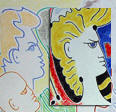 The mirrored figure looks very much like the person that could well be identified as the 'young Cocteau' in the last supper. Again it appears as if the artist has put himself into the scene. It would be a logical step to suggest Cocteau was a member of the Knights of the Holy Sepulchre. Perhaps not an ordinary member.
Below the Blason, on both sides of the entrance, a figure, wearing a hat with the Jerusalem Cross, holds out his hands with the thumbs touching in the old Jewish symbol for divinity.
The mirrored figure looks very much like the person that could well be identified as the 'young Cocteau' in the last supper. Again it appears as if the artist has put himself into the scene. It would be a logical step to suggest Cocteau was a member of the Knights of the Holy Sepulchre. Perhaps not an ordinary member.
Below the Blason, on both sides of the entrance, a figure, wearing a hat with the Jerusalem Cross, holds out his hands with the thumbs touching in the old Jewish symbol for divinity.
Cocteau, the Meticulous Director
Jean Cocteau firmly believed he would transcend time and space after his death, just like the man he shared the intials with: Jesus Christ. This re-birth would not take place in this life though. It's hard to tell exactly what Jean Cocteau had in mind when he designed the Chapel of Notre Dame de Jérusalem. When Jean Martinon asked him to design a Chapel for his Ideal City, Cocteau must have thought to create the Ideal Chapel. Sensitive as he was, he perhaps even had a premonition of death lurking round the corner, pushing him to make his last enigmatic work the most explicit of them all. A perfect symbiosis of shape and image. Did Cocteau hide something or the exact opposite? In either case, you can count on everything being there for a reason. You have to remember Jean Cocteau was a celebrated film director. He was known for meticulously detailing out his themes and messages. A micro-director, obsessed with the right word in the right line in the right poem. The right person in the right clothes in the right spot on the stage. Cocteau didn't leave anything in his art to chance. He was very articulate. A symbolyst; certainly not an impressionist.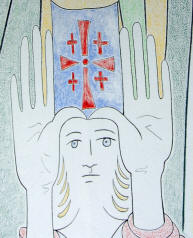 So what is the symbology here and what could the master have meant to say?
My guess is that the octagonal shape was meant to guard knowledge in this place for eternity. In a great double meaning of the same octagon it looks like that knowledge had everything to do with the alleged resurrection of Christ. The outer and the inner octagon.
Cocteau tells us Mary had sins and gave birth to the Infant Jesus through natural conception. He died on the cross and changed his earthly kingdom for a heavenly one. The artist appears to be telling Christ didnot return and won't return at the Apocalypse. While the Crusader priests pray and chant, Christ sheds tears over them in heaven where he was just reborn as symbolised by the Scarab.
At the Last Supper all eyes are on Mary Magdalene. Remember Cocteau painted this in an age where everybody still believed she was nothing but a foul footnote in the bible. Cocteau emphasises her role even more in the resurrection, straight opposite the Last Supper. Not Christ but Mary Magdalene exits the tomb with a serene expression on her face. She knows he's in heaven and won't be back. It's clear now who Our Lady of Jerusalem is: Mary Magdalene.
If this is what Cocteau meant to say, how does the Order of the Knights of the Holy Sepulchre fit the picture? If the previous interpretation is correct, guarding Christ's tomb would become a whole lot more relevant than it would be when he had walked out of it after his death. It would mean his mortal remains where laid to rest and perhaps still are somewhere today. In that respect the 'J' and inverted 'J' symbols are quite clear in their meaning: he, Jesus, is up there, not here.
Dieu le Veult, God wills it, however not as they thought he wanted it in the 10th century. Jean Cocteau, appears to show us the Crusaders went on a conquest for all the wrong reasons but found a Holy Sepulchre, worthy to protect through all times.
©2007-2012 renneslechateau.nl, all rights reserved
Additional credits:
Mairie et Office du Tourisme Fréjus
The Crusades, Robert Payne
Discussions on www.terugnaardebron.com internet forum
Original photos Corjan Mol
Panorama photo copyright Antonio Moya, many thanks!
This article was previously published on Andrew Gough's Arcadia
So what is the symbology here and what could the master have meant to say?
My guess is that the octagonal shape was meant to guard knowledge in this place for eternity. In a great double meaning of the same octagon it looks like that knowledge had everything to do with the alleged resurrection of Christ. The outer and the inner octagon.
Cocteau tells us Mary had sins and gave birth to the Infant Jesus through natural conception. He died on the cross and changed his earthly kingdom for a heavenly one. The artist appears to be telling Christ didnot return and won't return at the Apocalypse. While the Crusader priests pray and chant, Christ sheds tears over them in heaven where he was just reborn as symbolised by the Scarab.
At the Last Supper all eyes are on Mary Magdalene. Remember Cocteau painted this in an age where everybody still believed she was nothing but a foul footnote in the bible. Cocteau emphasises her role even more in the resurrection, straight opposite the Last Supper. Not Christ but Mary Magdalene exits the tomb with a serene expression on her face. She knows he's in heaven and won't be back. It's clear now who Our Lady of Jerusalem is: Mary Magdalene.
If this is what Cocteau meant to say, how does the Order of the Knights of the Holy Sepulchre fit the picture? If the previous interpretation is correct, guarding Christ's tomb would become a whole lot more relevant than it would be when he had walked out of it after his death. It would mean his mortal remains where laid to rest and perhaps still are somewhere today. In that respect the 'J' and inverted 'J' symbols are quite clear in their meaning: he, Jesus, is up there, not here.
Dieu le Veult, God wills it, however not as they thought he wanted it in the 10th century. Jean Cocteau, appears to show us the Crusaders went on a conquest for all the wrong reasons but found a Holy Sepulchre, worthy to protect through all times.
©2007-2012 renneslechateau.nl, all rights reserved
Additional credits:
Mairie et Office du Tourisme Fréjus
The Crusades, Robert Payne
Discussions on www.terugnaardebron.com internet forum
Original photos Corjan Mol
Panorama photo copyright Antonio Moya, many thanks!
This article was previously published on Andrew Gough's Arcadia